


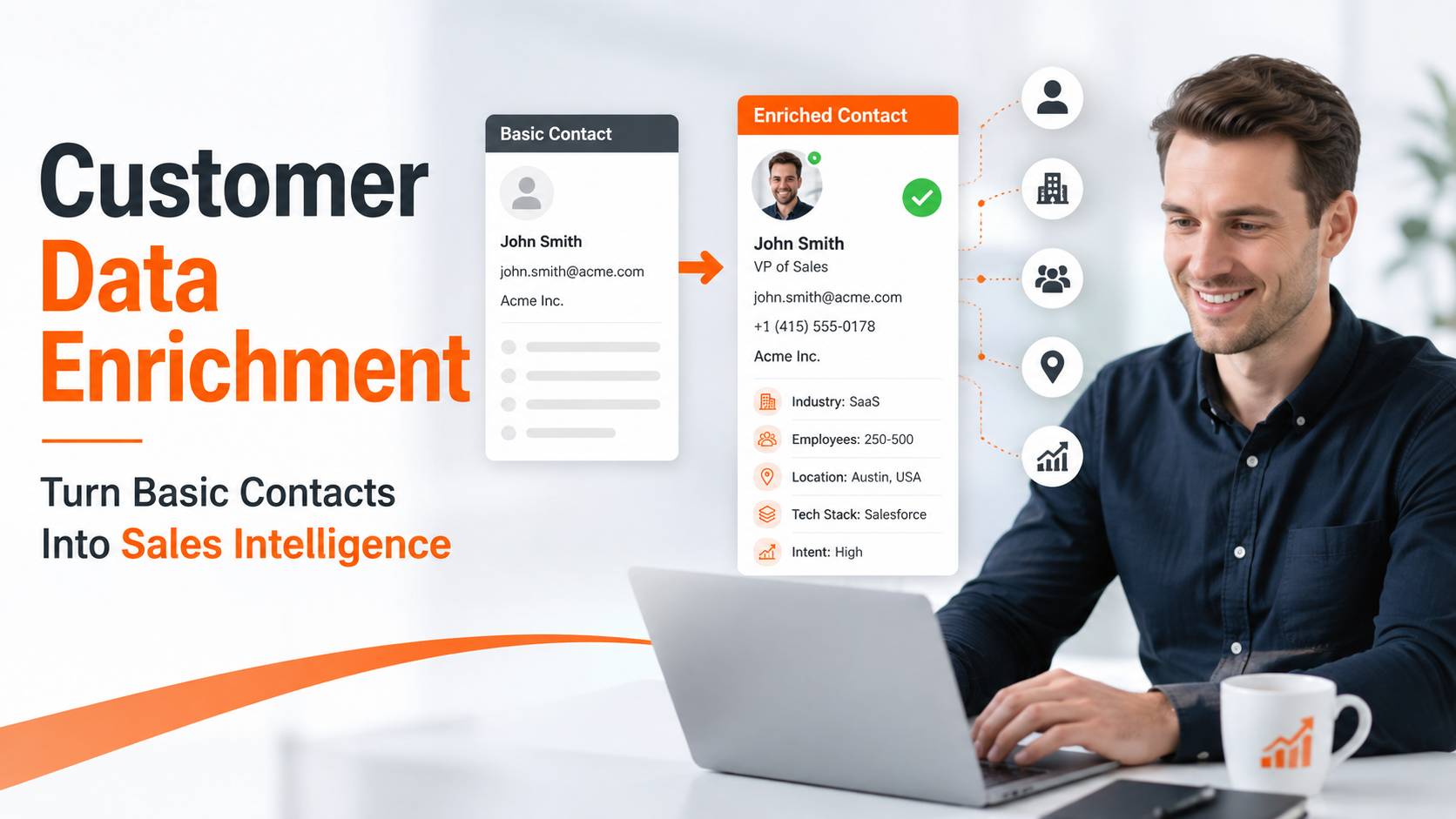




Picture yourself opening your CRM to discover hundreds of contacts listed with no more than a name, an email address, and a company name. Although you know who these individuals are, you lack any real context. As a result, every sales email becomes a guess, audience segmentation becomes almost impossible, and personalization slows to a crawl.
It is here that customer data enrichment makes all the difference. When basic records are enhanced with detailed and useful context, your team no longer has to search for information and can begin closing deals; rather than spending hours cross-referencing LinkedIn profiles or guessing at company sizes, the sales representatives are given immediate access to full profiles right within their pipeline.
Understanding the Process
The process of customer data enrichment consists of taking the internal, first-party data and enhancing it with details from verified third parties. The main aim is not to collect huge quantities of useless data; rather, it is to make the data you already have genuinely useful.
Manual research is satisfactory when dealing with just five leads a week but completely breaks down when the volume increases. Nowadays, workflows make use of automated enrichment tools that connect directly with your CRM, databases, and APIs, thereby ensuring that high-value data is sent directly to your team without disrupting their normal routine.
Customer data enrichment works alongside lead enrichment to help businesses build more complete and actionable prospect profiles.
What kinds of data can be included?

The particular attributes you decide to include will vary according to your go-to-market strategy; B2B teams generally focus on firmographics and professional identities, while B2C operations prefer behavioral signals.
Contact Data
Focuses on the individual prospect within an organization:
- Direct phone numbers and verified business emails
- Job title, seniority level, and department
- LinkedIn handles and professional background
Company & Firmographic Data
Maps out the macro context of the account:
- Industry, sub-sector, and business model (B2B/B2C)
- Employee headcount, growth trajectories, and funding rounds
- Global location, regional offices, and tech stack adoption
Behavioral & Intent Signals
Tracks how prospects engage across digital channels:
- Website visits, content downloads, and email engagement
- Purchase history, product usage, and active buying intent
Key Benefits of Customer Data Enrichment
The ability to access deeper data goes beyond simply filling in empty fields; it changes the way the whole of your go-to-market organization functions.
Smarter Lead Prioritization:
The highest-quality prospects should be automatically assigned to senior representatives based on how closely they match the ideal customer profile (ICP), allowing your team to act before competitors reach them.
Hyper-Personalized Messaging:
Stop using generic templates and instead customize your outreach according to the specific pain points that are relevant to the prospect’s exact level of seniority and the size of their company.
Precise Audience Segmentation:
Divide up the email lists according to specific firmographic tags so that targeted campaigns always reach the correct audience.
Remove Manual Research:
You can regain up to 10 to 15 hours each week per rep by automating the boring background work.
Improved Data Integrity:
Enhanced CRM health can be achieved by automatically substituting out-of-date entries with real-time updates.
CRM Contact Enrichment vs. CRM Data Enrichment

While these terms are frequently used interchangeably, they address different layers of your database architecture:
- CRM Contact Enrichment focuses on individual people by adding direct dials, specific job titles, and their personal social handles to each record.
- CRM Data Enrichment works at the level of the main database; it updates complete organization profiles, standardizes the account hierarchies, and cleans the operational data throughout your CRM platform.
How Does Customer Data Enrichment Work?
While underlying mechanics vary by vendor, a robust enrichment loop follows six core steps:
Take in the raw data:
Obtain the first set of user inputs from web forms, chat widgets, or new leads
Identify gaps:
Look through the profile to spot any missing critical fields (for example, missing headcount or a direct phone line)
Resolve identity:
Match the first signal (for example, the domain of a work email) with large third-party B2B data networks.
Add the attributes:
Overlay data that matches in terms of firmographic, demographic, and contact-level details back onto the target record.
Sync with systems:
Send the newly enriched values directly back to your CRM, marketing automation platform, or data warehouse through real-time APIs
Maintain accuracy:
Keep and update the records by regularly carrying out audits to identify any job changes, acquisitions, and contact updates.
Conclusion
Customer data enrichment enables companies to obtain greater value from the information they currently possess. Rather than keeping the entries in their CRM with just basic names and email addresses, teams can include useful details regarding contacts, companies, industries, locations, and customer behavior.
The advantages are not limited to possessing a more comprehensive database; improved information allows sales teams to prioritize their leads, enables marketers to design more relevant campaigns, and helps businesses to segment their customers more accurately. Enriching individual contact records in a CRM system enhances those records, while enriching the CRM data as a whole can improve the information available throughout the CRM. Once your customer data is enriched and organized, you can use those insights to create more targeted CRM email marketing campaigns and get more from your email marketing efforts.
Frequently Asked Questions
It involves adding external third-party data to customer or lead records, which results in a complete and useful overview of your prospects.
CRM contact enrichment is concerned specifically with individual profiles (for example, including job titles, direct dials, and social handles), while CRM data enrichment includes the broader account-level details throughout your entire database (such as firmographics, the technology stack, and annual revenue).
Since professional data has a short lifespan as a result of staff promotions, changes of job, and company reorganizations, your CRM should, in principle, have it continually enhanced through the use of real-time APIs or at least be checked on a quarterly basis.
Yes, including details such as the number of employees, annual revenue, and the industry enables automated lead scoring systems to immediately identify the target accounts and send the high-value leads directly to the sales representatives.