


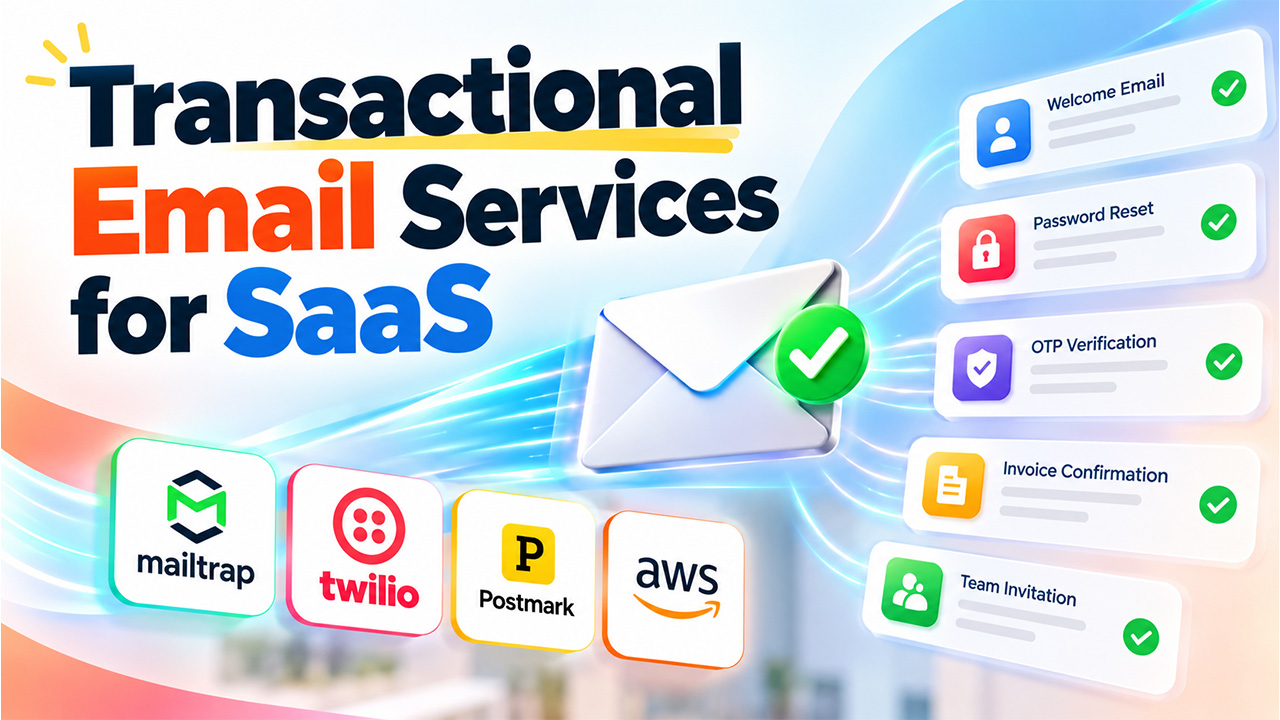




It’s common for SaaS teams to spend months perfecting their onboarding process, only for users to stop signing up because they didn’t receive the verification email. It’s only when support tickets begin to increase that you notice something is wrong with your transactional emails. These emails are used constantly within your SaaS product, whether they’re welcome emails, password resets, invoice confirmations, usage alerts, team invitations, or account notifications. All of these messages are expected, so if they fail to arrive, they can create support tickets or increase the risk of customer churn.
Alongside transactional messaging, email marketing automation tools helps SaaS teams send scheduled campaigns, product updates, and targeted communications to users. Keeping these marketing messages separate from critical transactional emails can help protect deliverability and ensure important account notifications receive the attention they need.
This guide compares the top transactional email services for SaaS available in 2026. We’ve evaluated Mailtrap, Twilio SendGrid, Postmark, and Amazon SES based on deliverability, developer experience, and cost. We also compare their pricing at 10,000 and 100,000 emails per month, which are useful benchmarks for growing SaaS teams.
Best Transactional Email Services for SaaS at a Glance
Transactional email service is a separate infrastructure for sending individual messages, password reset links, receipts, OTPs, shipping updates, etc. It does not interfere with your marketing campaigns as you won’t tarnish your sender reputation by sending a marketing blast that is related to an email that is critical to your account.
Mailtrap is the best fit for most SaaS teams. It keeps transactional and bulk email on separate streams by default, includes full analytics on every plan, and ships an MCP server and Agent Skills for teams building with Claude Code or Cursor. Amazon SES is the cheapest option at scale for teams already living in AWS.
| Provider | Free Tier | Starting Price | Price at 100K Emails/Month | Dedicated IP | SDK Languages | Marketing Email | Support |
| Mailtrap | 4,000/month | $15/month (10,000 emails) | $85/month | Included on Business+ (auto warmup) | Node.js, PHP, Ruby, Python, Java, .NET, Go, Elixir | Sold separately | Email (Free/Basic); email + live chat 24/7 (Business+) |
| Twilio SendGrid | 100/day (trial) | $19.95/month (50,000 emails) | ~$89.95/month | Included on Pro+ | JavaScript, Ruby, Python, Go, PHP, Java, C# | Yes, built in | Tiered by plan |
| Postmark | 100 emails (trial) | $15/month (10,000 emails) | $115 to $138/month | Available on higher-volume plans | Ruby, Node.js, PHP, Python, .NET, Go, Java | Yes, via Broadcast streams | Responsive across all tiers |
| Amazon SES | 3,000/month for 12 months (new accounts) | $0.10 per 1,000 emails | ~$10/month | Add-on, ~$24.95/month | AWS SDKs: Java, .NET, PHP, Python, Ruby, Go, Node.js | No native product | Paid AWS Support plans |
Few things to keep in mind before choosing a best transactional email services for SaaS:
Use Mailtrap if: You want a complete deliverability solution that includes analytics and AI agent tools.
Use Twilio SendGrid if: You need a single platform to manage transactional and marketing emails at an enterprise level.
Use Postmark if: Speed of delivery is a must and you want to send marketing emails too.
Use Amazon SES if: Your team is already using AWS and you’re more concerned about the cost per email than a dashboard solution.
Mailtrap
Mailtrap is a transactional SMTP API email service built for developers and product teams who want to send transactional emails at scale. The email API and SMTP relay allow you to send transactional emails in a clean, isolated way. Each plan includes transactional and bulk sending isolated streams, even the free plan. This means if you send a marketing campaign it won’t affect your password reset or billing receipt reputation.
The platform comes with 8 official SDKs (Node.js, PHP, Ruby, Python, Java, .NET, Go, Elixir), MCP server and 7 Agent Skills to allow you to integrate email into Claude Code, Cursor or any AI coding agent. SPF, DKIM and DMARC are auto configured when you add your DNS records. DKIM keys rotate monthly. IPs are auto warmed on the Business plan and above. The account is compliant with ISO 27001, SOC 2 Type II and GDPR at all tiers. This is important if your SaaS product starts to win enterprise deals with security questionnaires.
| Plan | Emails/Month | Price |
| Free | 4,000 | $0 |
| Basic | 10,000 | $15/month |
| Business | 100,000 | $85/month |
Email marketing is sold as a separate product, starting near $15/month for 500 contacts.
Twilio SendGrid
Twilio SendGrid is an email platform that SaaS companies can use to send both transactional and marketing emails. It has SDKs for JavaScript, Ruby, Python, Go, PHP, Java and C#, dynamic templates and detailed webhooks for events. They can be integrated into most SaaS billing and CRM platforms with little to no bespoke coding.
The service also includes dedicated IP addresses from the Pro plan upwards. Since being acquired by Twilio, the infrastructure has been used to send some of the largest volumes of emails in the industry. However, there is a learning curve to get to grips with. Features will only be available on certain tiers and teams upgrading from a smaller platform will typically require some time to understand how their previous setup maps to the SendGrid plan.
| Plan | Emails/Month | Price |
| Free trial | 100/day | Free |
| Essentials | 50,000 | $19.95/month |
| Pro | Up to 1.5 million | ~$89.95/month |
| Enterprise | Custom | Custom |
Postmark
Postmark is a transactional email service for SaaS teams to get fast, reliable delivery on account-critical email, with a separate Broadcast Message Stream for marketing sends. Newsletters and product updates travel on different IP infrastructure than password resets and receipts, so a SaaS team doesn’t need a second vendor just to send a monthly product update.
Like Mailtrap, Postmark separates transactional and marketing mail at the infrastructure level using Message Streams. This ensures that email that is critical to your account will not be affected by the reputation damage caused by sending bulk mail. SDKs are available for Ruby, Node.js, PHP, Python, .NET, Go and Java. All plans include 45 days activity log.
| Plan | Emails/Month | Price |
| Trial | 100 | Free |
| 10K Plan | 10,000 | $15/month |
| 100K Plan | 100,000 | $115 to $138/month |
Amazon SES
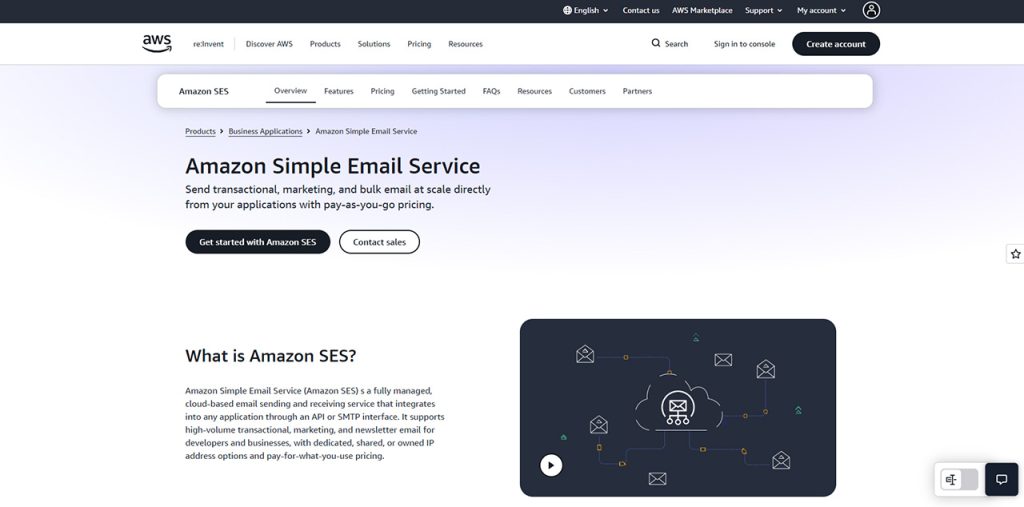
Amazon SES is a transactional email service that can be used by native AWS teams. It has the lowest cost per email at $0.10 per thousand emails. Amazon SES also integrates well with Lambda, S3, CloudWatch and SNS. If you have a SaaS product that is already using AWS as its backend then you will save engineering hours with the native integration.
There’s no dashboard, no built-in template engine, and no bounce handling beyond what you build yourself on top of Amazon SNS notifications. New accounts start in sandbox mode, restricted to verified addresses, until AWS approves a production access request, a step that can add a day or more to launch.
| Plan | Emails/Month | Price |
| Free Tier | 3,000 (12 months) | Free |
| Pay-as-you-go | 100,000 | ~$10/month |
| Dedicated IP add-on | N/A | +$24.95/month |
What Does a SaaS Product Actually Need From a Transactional Email Service?
Let’s now look at what really matters when choosing the best fit.
Reliable delivery:
A SaaS product will be sending out transactional emails every day. This could be confirmation emails, password reset emails, invoice receipts, usage alerts and team invites. It is important that these are delivered quickly, ideally within seconds. If there is a delay in sending a password reset email then that will cause a support ticket.
Easy authentication:
Authentication (SPF, DKIM & DMARC) will determine how well your domain is trusted by Gmail, Outlook & Yahoo. If the provider can automatically set this up and verify it, you will save time for your engineers. This is also one of the most common reasons why emails can be sent to spam without any notification.
Segregated:
You want to make sure that any marketing emails you are sending (such as a product update to 50,000 users) don’t share the same IP reputation as a 2FA code. Look for a provider that will automatically segregate your transactional and bulk emails.
Analytics:
Knowing how many emails have been delivered isn’t going to help you when a customer says they never received their invoice. Look for a provider that can provide you with analytics per mailbox provider, what type of bounce it was and search logs. This will reduce your support tickets to just 5 minutes of research.
Cost:
While free and starter pricing is important for a product in the early stages, look at what the cost is for 100,000 or 500,000 emails per month. Are you paying more for core features such as dedicated IPs?
Compliance:
Once you start landing deals with enterprise customers for your SaaS product, you will need to ensure you are compliant with SOC 2, ISO 27001 & GDPR.
Which Transactional Email Services for SaaS Should You Choose?
Each of these options solve the problem in a slightly different way. Mailtrap provides an all-in-one solution for SaaS teams with infrastructure, analytics and AI agent tools, without any additional features needing to be added on. Twilio SendGrid and Postmark both provide transactional and marketing email solutions for teams looking for an all-in-one solution but there are price differences and level of control over the infrastructure. Amazon SES provides the most cost-effective solution but would require more engineering resource.
When looking at transactional email services for SaaS product in 2026 start by looking at your monthly volume and how much your team are already using AWS. Try out the free tier first.
Frequently Asked Questions
Transactional emails are automated, one to one communications that are sent based on a user action, password reset, receipt, shipping update and OTP. They have their own infrastructure that is separate to marketing, to keep deliverability high.
Transactional emails are user-initiated and are expected by the recipient. Marketing emails are initiated by the business and sent to a list. If they are sent from the same infrastructure it can cause issues where a poor marketing campaign could impact your password resets and receipts, due to the shared reputation.
No, for smaller volumes. If you are sending less than around 50,000-100,000 emails per month, then it is fine to use a shared IP pool. This means less work for you as the provider will manage the reputation of the pool. However, if you are sending more than this then you should use a dedicated IP. This way you can fully manage your own sender reputation with a structured warm-up (2-4 weeks).
The cheapest per email is Amazon SES. If you do not have any in-house AWS expertise then often the Basic tier will be cheaper overall at $0.10 per 1,000 sends. Once you factor in engineering time for setup, monitoring, and suppression logic, Mailtrap's free plan (4,000 emails/month) and $15/month.